


Whether you have never played a trick-taking game before or you just want the passing rules straight, everything below is written to get you into a hand quickly. No prior card-game experience needed.
Key Takeaways
- Free in the browser, no download and no account: the game runs on this page against 3 AI opponents.
- Low score wins. Hearts are 1 point each, the Queen of Spades is 13, and the game ends the moment any player reaches 100.
- You cannot lead a heart until hearts have been "broken" by someone discarding one on an earlier trick.
- Shooting the Moon reverses everything: take all 13 hearts and the Queen of Spades in one hand and you score 0 while everyone else takes 26.
- The difficulty setting changes the cards you are dealt. We measured four hands directly; the results are below.
Scoring at a Glance
| Card | Points | Notes |
|---|---|---|
| Each heart (♥) | 1 | 13 hearts in the deck, so 13 points are in play per hand |
| Queen of Spades (Q♠) | 13 | The single most costly card in the game |
| Every other card | 0 | Clubs, diamonds and the other spades are harmless |
| Total per hand | 26 | All 26 points go to someone every hand |
| Shooting the Moon | 0 for you, 26 each for everyone else | Requires all 13 hearts and the Q♠ |
The game ends when any player reaches 100 points, and the player with the lowest total at that moment wins. Each seat on the table shows its running score next to that 100-point target.
How to Play Hearts
Starting a game
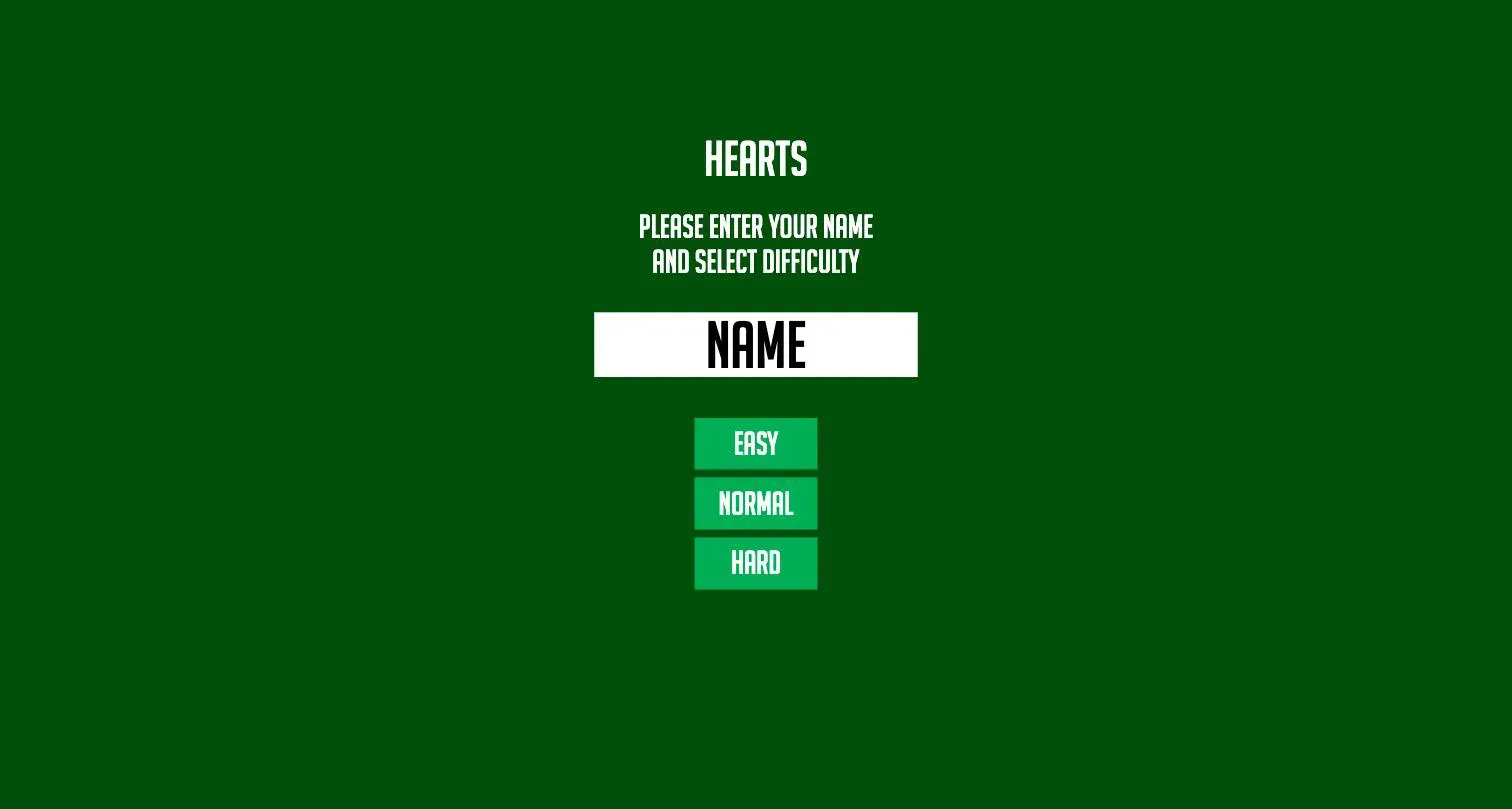
Enter a name and pick a difficulty to sit down. One detail worth knowing: the name box arrives with the word "NAME" already in it as real, editable text rather than as a greyed-out placeholder, so clear it before typing or your name will be inserted into the middle of it.
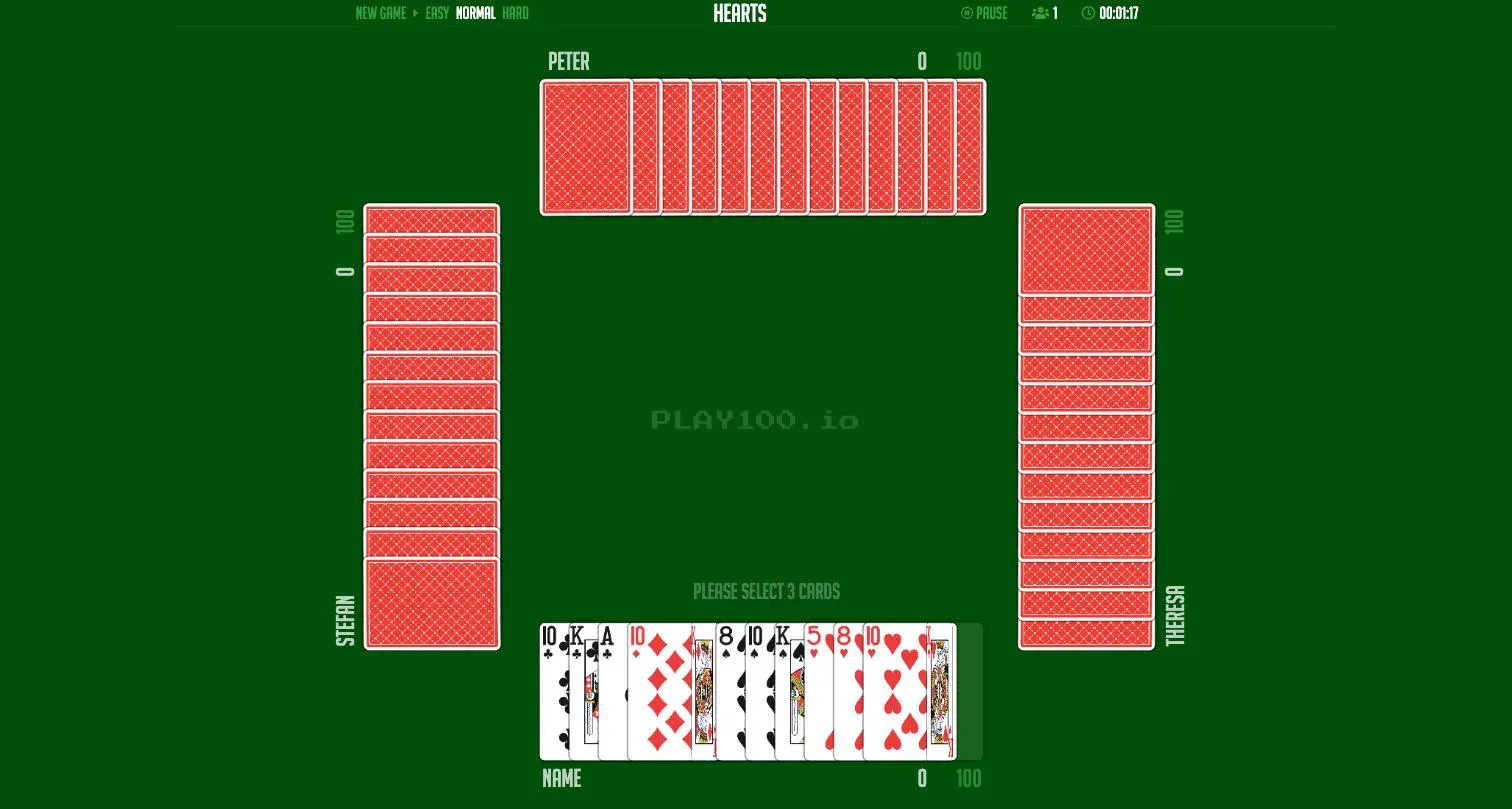
Your three opponents are drawn from a pool of names rather than being fixed. Across our sessions the table was dealt to Peter, Stefan and Theresa in one game and Claudia, Peter and Stefan in the next.
Setup
Four players sit at the table: you against three AI opponents. All 52 cards are dealt out, giving every player exactly 13 cards.
The passing phase
Before a single card is played, each hand opens with a pass: you choose 3 cards from your hand to hand to another player, and receive 3 in return. Which direction the pass travels rotates from hand to hand:
| Hand | Pass direction |
|---|---|
| 1st | Left |
| 2nd | Right |
| 3rd | Across |
| 4th | No pass at all |
After the fourth hand the cycle repeats from the beginning. The prompt on this page reads simply "PLEASE SELECT 3 CARDS" without naming the direction or the recipient, so it is worth tracking which hand of the cycle you are on yourself. Selected cards drop downward out of the fan to show they are chosen.
Controls
Click or tap any valid card in your hand to play it into the trick. Touch controls work the same way on mobile, so nothing changes moving between a phone and a desktop. A top bar carries New Game, the three difficulty buttons, a Pause control and a running game timer.
The rules
- Whoever holds the 2 of Clubs plays it first, which starts the opening trick.
- You must follow the suit that was led if you hold a card in it. If you hold none, you may play anything.
- The highest card of the suit that was led wins the trick, and the winner leads the next one. Aces are high.
- Each heart taken is 1 penalty point; the Queen of Spades is 13.
- Hearts cannot be led until they have been broken, meaning someone has already discarded a heart on a trick led in another suit.
- Shooting the Moon: collect all 13 hearts and the Queen of Spades in a single hand and you score 0 while all three opponents take 26 each.
- The game ends as soon as any player hits 100 points. Lowest total wins.
Rule 3 is the one that catches new players. Winning a trick is not a good thing here. Every trick you take is a trick whose hearts land in your pile.
A Worked Example
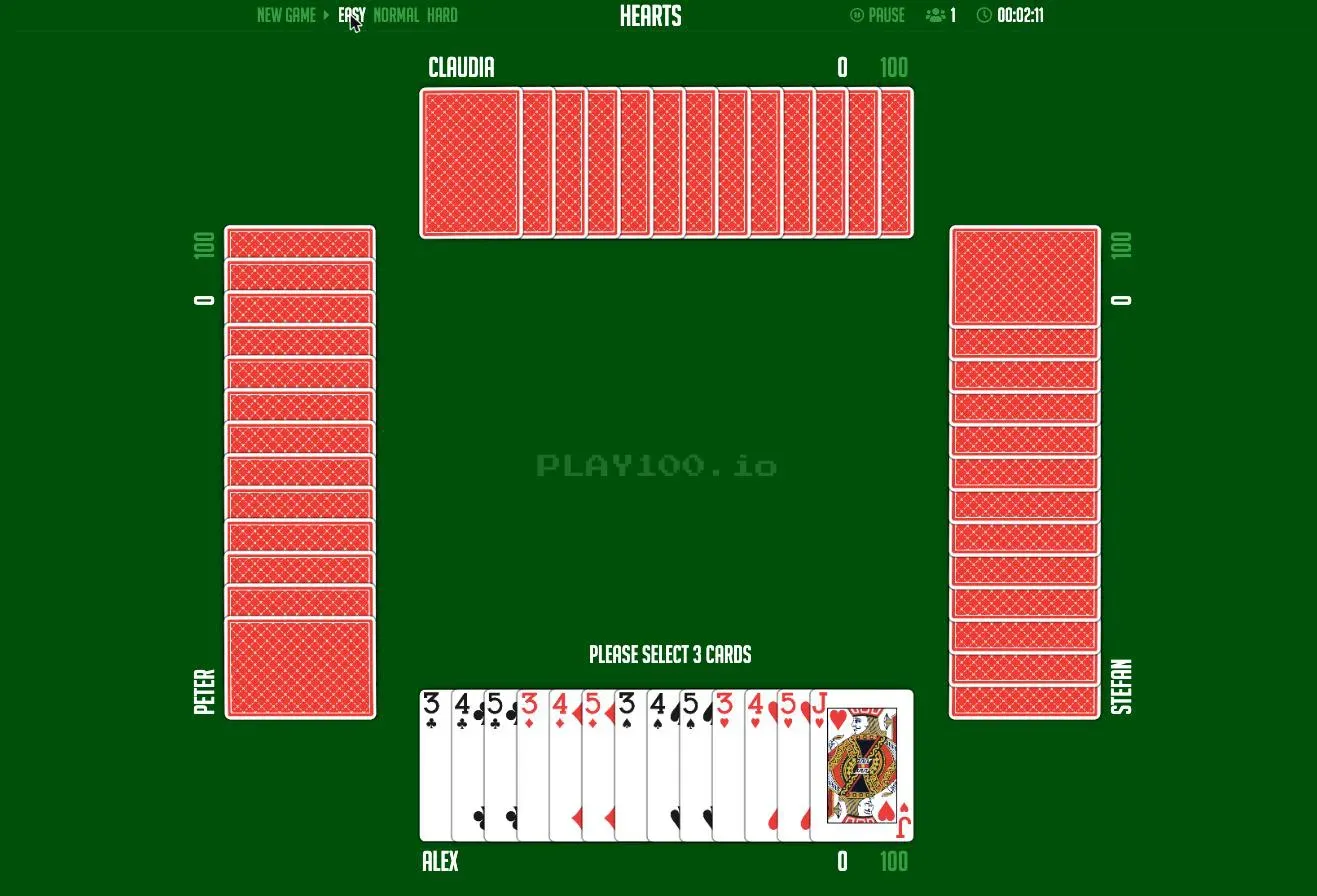
Here is a real hand this site dealt us on Easy, played out against the rules above:
Your hand: 3♣ 4♣ 5♣ · 3♦ 4♦ 5♦ · 3♠ 4♠ 5♠ · 3♥ 4♥ 5♥ · J♥
Work through what that hand can and cannot do:
- You do not lead first. You have no 2♣, so whoever holds it opens (rule 1).
- Clubs are led. You hold 3♣, 4♣ and 5♣, so you must follow suit (rule 2). Any of the three is almost certainly the lowest card played, so you will not take the trick, and you take no points.
- The same is true in every suit. With nothing above a 5 outside the J♥, you lose nearly every trick you are involved in, which is exactly what you want.
- The J♥ is your one liability. It is a heart, so it carries a point, and it is high enough to actually win a trick late in the hand once the higher hearts are gone. It is the obvious card to pass away in the passing phase.
- Shooting the Moon is off the table. Taking all 13 hearts requires cards that can win tricks, and this hand has almost none. Play for a clean zero instead.
The general lesson generalizes past this hand: count how many of your cards can realistically win a trick. That number, not the number of hearts you hold, is what tells you how much danger you are in.
What the Difficulty Setting Actually Changes
Most Hearts sites offer difficulty levels without saying what they alter. We measured it on this game directly.
Method: four hands dealt on 2026-08-22, in one session, reading the opening 13 cards before the pass. Two hands on Easy, one on Normal, one on Hard.
| Difficulty | Opening hand dealt |
|---|---|
| Easy (1st) | 3, 4, 5 of all four suits, plus A♦ |
| Easy (2nd) | 3, 4, 5 of all four suits, plus J♥ |
| Normal | 10 and K of all four suits, plus 7♣, J♣, 8♦, 7♠, 6♥ |
| Hard | 10, Q, K of all four suits, plus 5♣ |
Two things stand out across all four hands. First, the deal is built out of whole ranks repeated across all four suits rather than looking like an ordinary shuffle. Second, the rank band tracks the difficulty setting: Easy dealt nothing above a 5 in its twelve-card core, Hard dealt nothing below a 10.
That is not cosmetic, because of rule 3. A hand of threes, fours and fives can barely win a trick, and a trick you never win is a trick whose penalty points go to somebody else. That is the mechanism that makes Easy easy. Hard inverts it: tens, queens and kings win tricks whether you want them to or not, and the Hard hand we were dealt contained the Queen of Spades itself, putting the 13-point card in your hand from the deal.
Practical consequence: on Hard, the passing phase matters far more than on Easy. Getting high spades out of your hand is the whole game. On Easy you can pass almost anything and still score close to zero.
Four hands is a small sample, and only the twelve-card core repeated exactly on the two Easy deals, with the thirteenth card differing each time. Treat the pattern as a strong observation about this game rather than a guarantee about every deal.
Strategy: Staying Away From the Queen of Spades
The Queen of Spades is worth half of every point available in a hand, so most of Hearts strategy is really Q♠ strategy.
- Pass your high spades away. The Ace and King of Spades are dangerous not because they score anything, but because they win spade tricks, and a spade trick is where the Queen turns up. If you hold the Queen herself, passing her is usually correct.
- You are not forced to play the Queen just because spades are led. Rule 2 only obliges you to follow suit. If you hold Q♠ alongside other spades, you can play a different spade and keep her back. You must play her only when she is your last remaining spade, or when you choose to discard her on a trick led in a suit you cannot follow.
- That discard is the Queen's best exit. The moment you are void in a suit somebody leads, you can throw the Queen into someone else's trick.
- Count the high spades. Once the A♠ and K♠ have been played, the Queen is the highest spade left and whoever leads spades is handing her to the trick winner.
- Low cards are safety, not weakness. Holding 2♠ and 3♠ means you can follow a spade lead without ever taking the trick.
Shooting the Moon
Shooting the Moon is the reversal: take every heart and the Queen of Spades in one hand and instead of 26 points you score 0, while each opponent takes 26.
It is high risk in a specific way. The attempt fails the instant a single heart goes to another player, and a failed attempt usually leaves you holding most of the hearts anyway, which is close to the worst possible result. Two conditions make it worth trying: a hand full of cards that can win tricks (aces, kings, long suits), and the Queen of Spades already in your possession. If you are watching an opponent take heart after heart, the counter is to make sure you take one yourself, which collapses their attempt entirely.
Worth knowing: the move is not original to Hearts. It first appeared in Britain in 1939 in a variant called "Hitting the Moon", per Wikipedia's history of the game.
Ready to Play?
That is the whole game: pass three, follow suit, duck the tricks that carry hearts, and above all stay clear of the Queen of Spades. If you are learning, start on Easy, where the deal itself keeps you out of trouble, and move up once ducking tricks feels automatic. Start a hand on this page and play a full game free against three AI opponents.